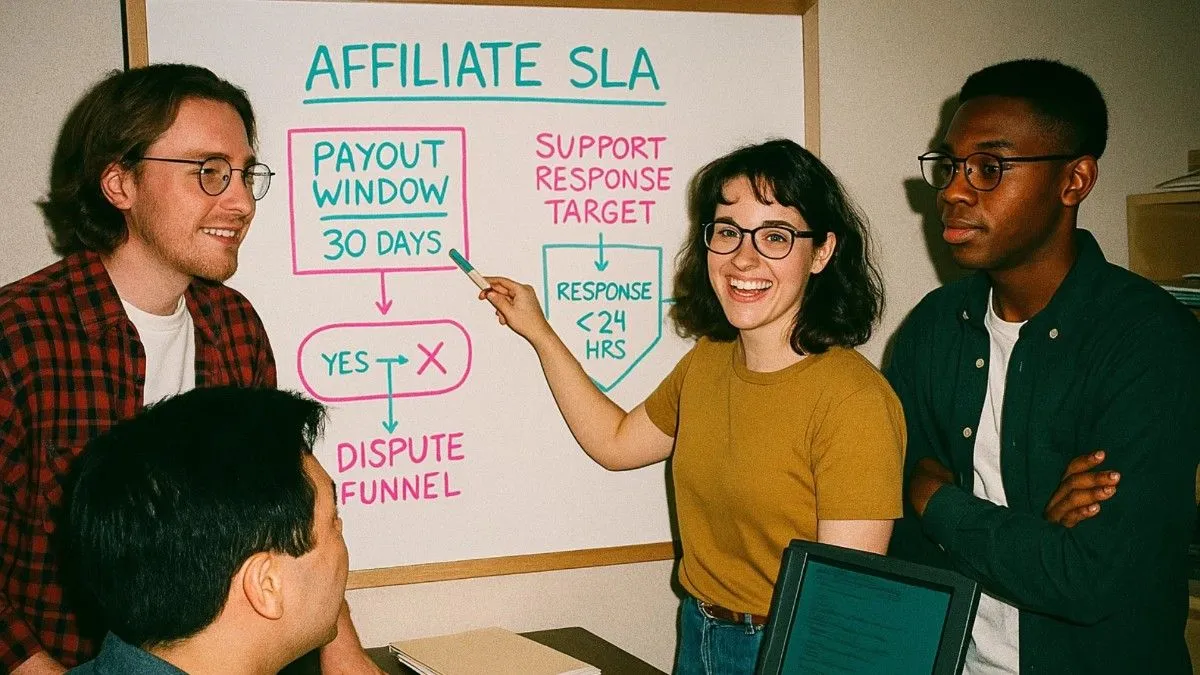
Quick answer: A strong affiliate program SLA sets clear expectations for response times, payout windows, dispute reviews, and partner support to keep affiliates engaged.
Table of Contents
- Why an affiliate program SLA matters
- Core SLA components: payout windows, response times, dispute rules
- How to define partner support metrics for affiliates
- Building payout workflows and dispute resolutions that scale
- Launch / Optimise Checklist
- FAQ
- Takeaways
Why an affiliate program SLA matters
Every affiliate marketing program runs on trust. Affiliates send traffic and sales because they believe the brand will credit conversions fairly, pay on time, and answer questions quickly. Without a formal affiliate program SLA, expectations stay vague and frustration grows. Clear rules protect both sides and reduce manual admin work, especially as your partner list expands.
Core SLA components: payout windows, response times, dispute rules
1. Affiliate payout SLA
Your payout window defines when affiliates can expect their earnings. Most brands use one of these models:
- Net-30 payout window: The most common. Gives time for cancellations, refunds, and fraud checks.
- Net-15 for VIP partners: Works for high-volume affiliates or premium creators who need faster cash flow.
- Instant or weekly payouts: Appealing for influencer-driven programs but requires automated verification tools.
A consistent payout SLA prevents the most common complaint affiliates raise: “When do I get paid?”
Tools like ReferralCandy automate post-checkout attribution, credit earnings correctly, and help maintain clear payout cycles. This keeps disputes low and partner satisfaction high.
2. Support response-time SLA
Affiliates expect timely help, especially around tracking questions or missing commissions. Define:
- First response time: e.g., 24 hours for general partners, 12 hours for top-tier creators
- Resolution expectations: e.g., 3–5 business days for typical cases
- Channels available: email, partner portal ticketing, or dedicated Slack groups for VIPs
If you offer both referral and affiliate support, note differences in response-type expectations. Programs that use a unified dashboard like ReferralCandy benefit from consolidated partner communication instead of tracking issues across multiple tools.
3. Dispute management rules
Affiliate disputes usually fall into three buckets:
- Attribution disputes (a sale wasn’t credited)
- Commission disputes (rate applied incorrectly)
- Fraud-related disputes (self-referrals, leaked codes, abusive traffic)
To reduce ambiguity, your SLA should cover:
- How affiliates submit disputes
- Review timelines (commonly 3–7 business days)
- Evidence requirements (screenshots, tracking links, timestamps, etc.)
- Final decision authority (brand holds final say)
Modern affiliate tools provide fraud detection such as IP checks, leaked code detection, and new-customer-only rules, which drastically reduce dispute volume.
ReferralCandy includes these protections by default, helping brands maintain clear compliance boundaries without manual review.
Note: An SLA only works when both parties understand affiliate marketing fundamentals and best practices — shared expectations are impossible without a shared understanding of how the channel works.
How to define partner support metrics for affiliates
Affiliate SLAs perform best when backed by measurable partner support metrics. These are the KPIs that describe whether you’re giving partners a reliable experience.
Core support metrics to publish
- Average response time: Time to first reply across all channels
- Time to credit a sale: How quickly conversions appear in the dashboard
- Payout timeliness: Percentage of payouts delivered within SLA
- Dispute resolution rate: Share of disputes resolved within agreed timelines
- Tracking accuracy rate: Percentage of affiliate orders attributed without manual correction
Top-tier programs track these metrics internally and display simplified versions in onboarding materials to build trust.
Why this matters
When brands maintain consistent support metrics, affiliates send more traffic. This pattern mirrors referral program behavior too, where visibility and friction removal lead to higher performance. For example, share rate jumps significantly when brands improve touchpoints and communication.
Building payout workflows and dispute resolutions that scale
Build a payout workflow that doesn’t rely on spreadsheets
Once you pass 10–20 active partners, manual calculations break. A scalable payout workflow includes:
- Automatic commission calculation
- Refund and cancellation adjustments
- Exportable reports for accounting
- Support for multiple currencies
- Partner dashboards showing payout status
ReferralCandy offers these in one system and reduces the need for external spreadsheets, a common pain point noted in affiliate tracking guides across DTC brands.
Define a clean dispute-resolution path
Create a predictable flow:
- Partner submits dispute (via portal or email)
- Brand acknowledges within SLA (e.g., 24 hours)
- Internal investigation
- Review link activity logs
- Check attribution windows
- Confirm order details
- Outcome shared with evidence
- Update partner dashboard and ledger
Launch / Optimise Checklist
- Publish affiliate program SLA covering payouts, responses, and disputes
- Set payout window (Net-30 recommended)
- Define support channels and response-time targets
- Add fraud rules
- Add payout and dispute timelines to your onboarding email
- Add a self-serve partner portal
- Test attribution logs and commission calculations
- Use ReferralCandy to centralize tracking and payouts for referrals and affiliates
Once your SLA is in place, explore ReferralCandy plans and pricing options to find the platform that gives you the tracking and reporting tools to hold both sides accountable to the terms you've agreed.
FAQ
What should an affiliate program SLA include?
A complete affiliate program SLA should define payout timelines, support response expectations, dispute handling rules, and fraud standards. It should also outline partner responsibilities, evidence needed for disputes, and how attribution works. Clear SLAs reduce confusion, speed up onboarding, and help you avoid manual support overhead—especially once you begin scaling and adding creators, coupon partners, or blog affiliates.
How long should my affiliate payout SLA be?
Most brands choose Net-30 because it allows time to validate orders, review any fraud signals, and account for cancellations. Some brands offer Net-15 or weekly payouts for high-performing partners, but only when using automated tools. The key is consistency. Once partners know exactly when funds arrive, they trust the program and stay active.
How do I manage disputes fairly?
Use evidence-based review: order logs, tracking links, attribution windows, and fraud signals. Communicate timelines clearly, acknowledge disputes quickly, and document decisions. A structured process prevents repeated back-and-forth. Many dispute cases disappear entirely when using platforms with built-in fraud detection and accurate tracking, such as ReferralCandy.
What partner support metrics should I publish?
Publish simple, measurable expectations: response time, payout punctuality, and dispute resolution windows. Providing these numbers boosts transparency and makes your program more attractive than competitors who offer vague “support available as needed.” Strong support metrics are especially valued by creators comparing multiple affiliate programs.
Takeaways
- A clear affiliate program SLA protects partner trust and keeps performance high
- Define payout windows, support metrics, dispute timelines, and fraud rules
- Automate tracking and payouts so your SLA is easy to uphold
- ReferralCandy offers unified tracking for referrals and affiliates, removing manual admin work