Post originally written in 2013; updated in January 2017.
You spend way too much time on it, and yet it's annoying as heck.
Why are people so darn annoying on social media?
Oddly, Google doesn't have the answers here.
Google "Why are people annoying on social media", and you're confronted with lists of examples, but no actual explanation. This is what we got:
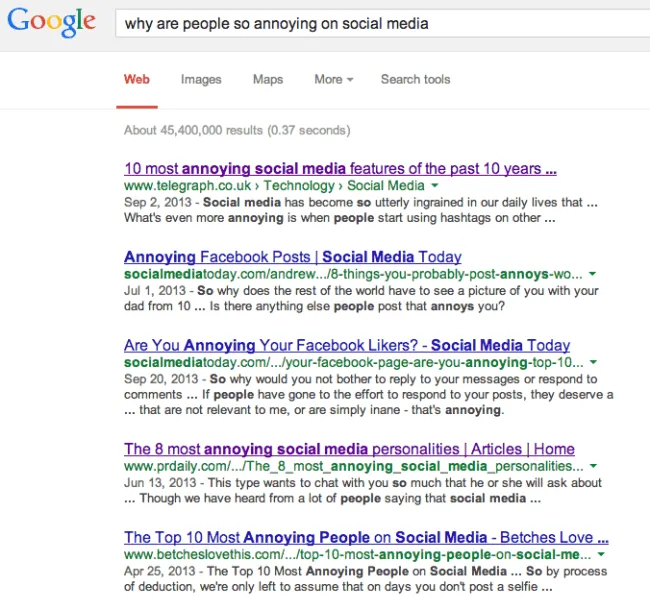
You didn't answer my question, Google!
So let's try answering it. After all, we believe that the convergence of communications and publishing is at the heart of everything we're interested in exploring today.
1: The ability to publish information at-large is relatively new.
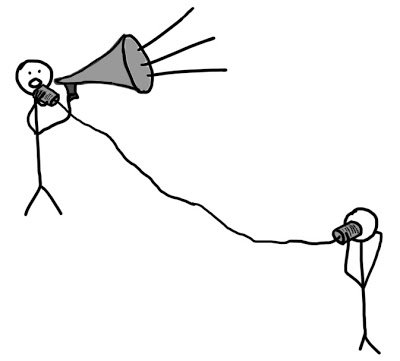
It's so new that we haven't learnt how to do it tastefully.
Publishing-by-the-masses hasn't been studied the way regular communication has, so we haven't collectively codified the do's and don't yet. We're still in the process of it.
We know, for instance, not to call somebody's telephone at 3 am in the morning. But does that also apply to a message on Facebook?
2: The presence of audiences turn us into self-serving performers.
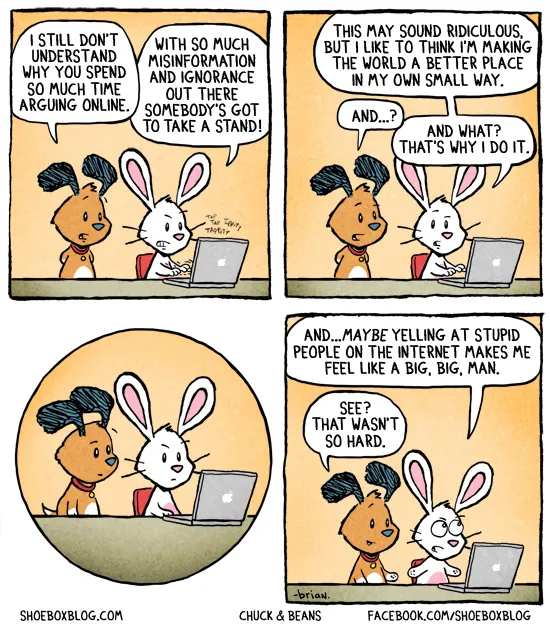
The above comic is actually very telling.
The rabbit's first explanation is the story that he wants to tell. It's the identity he constructs. He likely believes it himself most of the time and doesn't give it a second thought.
The second explanation is the real reason why he does it. And he wouldn't be able to feel like a "big, big, man" if not for the presence of the audience. The audience validates him.
In The Presentation Of Self In Everyday Life, sociologist Erving Goffman uses theatre as an illuminating metaphor for social life. We deliver performances to one another and to ourselves, and in doing so we determine our own (and each other's) identities.
Here are some quotes from Foucault and Social Media: Life In A Virtual Panopticon, a series of 3 blog posts on PhilosophyForChange. Highly recommended.
Here are some relevant quotes:
- "Sharing content is not just a neutral exchange of information. Mostly, when we share content on social media services, we do it transparently, visibly, in the presence of a crowd. The act of sharing... is a performative act." Word-of-mouth sharing strategies work with that performative instinct — giving customers a rewarding reason to share your brand publicly in front of the audiences who matter most to them.
- "There are no guards and no prisoners in Facebook’s virtual Panopticon. We are both guards and prisoners, watching and implicitly judging one another as we share content."
- "Forget Farmville and World of Warcraft. Creative self-affirmation is the most popular game online. We play this game whenever we select material to share with friends or craft messages to frame our posts. The name of the game is to present oneself, via one’s tweets, posts, likes, comments, and shares, in the light in which one aspires to be viewed. This essentially amounts to affirming the things that one loves in such a way that the loved one brings to the world is reflected in one’s online activity.
- "No doubt this satisfies a deep psychological need for recognition. Whatever it is that drives it, it draws us back to share and share again."
More recommended reading: I Tweet, Therefore I Am.
3: We're interacting with constructed Profiles, not persons. This can be intensely draining.
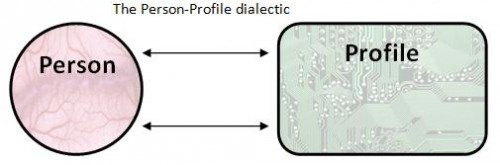
“The real world is the place where we take pictures for Facebook.”
In The Data Self (A Dialectic), Nathan Jurgenson offers the compelling argument that our profiles create us just as much as we create them.
Our Profiles serve us, but we also live in service of our Profiles. We colloquially describe this as "doing it for the 'gram", or "doing it for the Likes" – when we actually do something we wouldn't otherwise do, so that we can serve our profiles. (This phenomena is alluded to in I Tweet, Therefore I Am.)
In his essay Keep your identity small, Paul Graham similarly advocates keeping your identity (your Persona, or your Profile) small to avoid the stresses and hassle of such performance.
This performance...
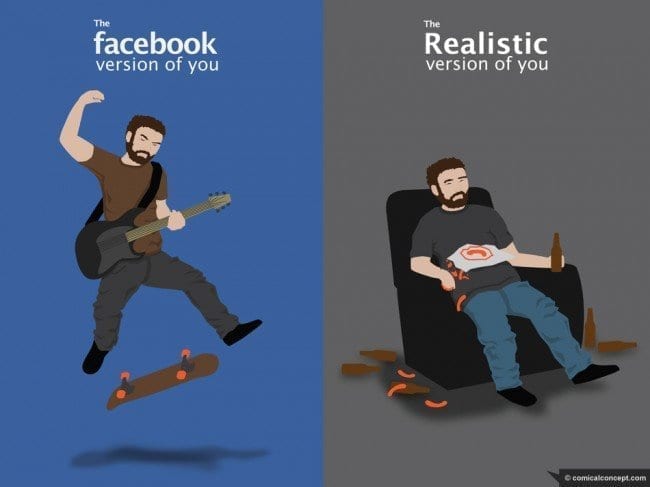
leads to this...
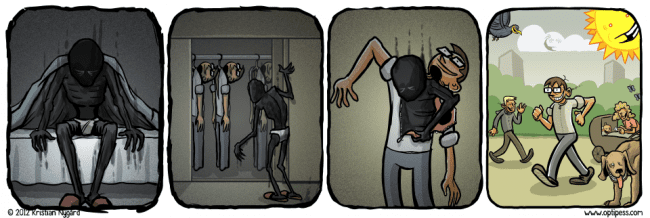
Interpretation: The guy is exhausted from having to put on a show all the time. With social media, the show continues online. It never ends.
If the user is not clear about this reality, this leads to...
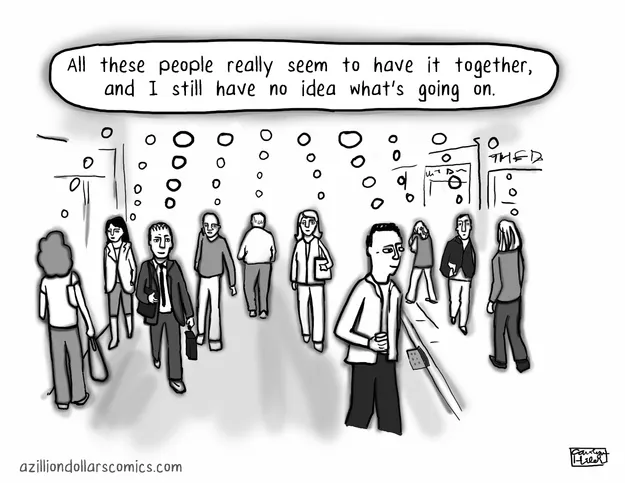
Which explains people being unhappy on Facebook.
This might seem strange at first glance. Isn't it social media?
It makes more sense when you realise people aren't interacting with people, they're interacting with profiles.
We're interacting with "presented Selfs", or constructs.
Minor disagreements blow up into major arguments because of the performance, and because of the war of identities. If you're not careful, it can get tiresome, tedious and difficult.
Here are some compelling dissections of social media:
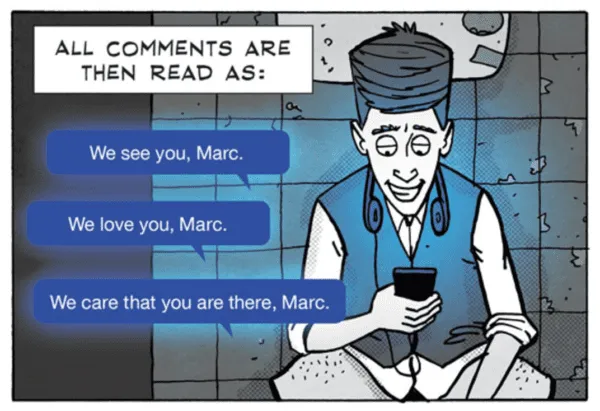
ZenPencils has comic with a quote by Marc Maron called The Social Media Generation. "Every status update is a variation of the same request: 'Would somebody please acknowledge me?'"
8 out of 9 examples on The Oatmeal's How to Suck at Facebook are depictions of excessive or unenlightened publishing. The one exception is "The Rash", which is an unenlightened response to the publishing of others. All of these demonstrate either ignorance or incompetence when it comes to what is socially acceptable.
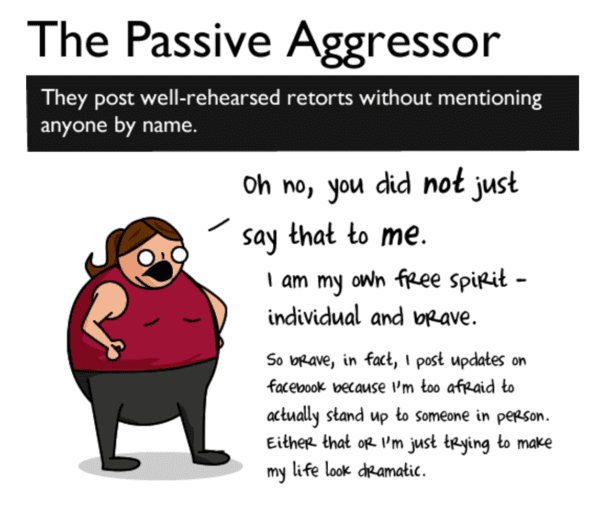
WaitButWhy.com is relatively new to the party, but their post 7 Ways To Be Insufferable On Facebook is remarkably insightful, and goes way beyond the list of annoying behavior. They reveal how annoying status updates are self-serving.
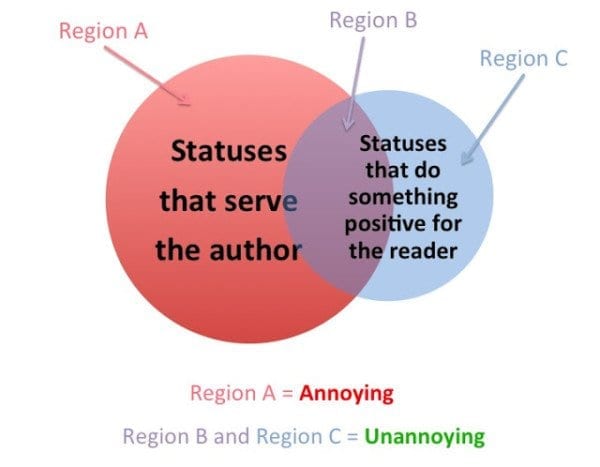
- In CollegeHumor's Twitter In Real Life, the hero walks around town making public declarations. It's funny because nobody actually does that. When you tweet "standing next to a hot chick", you probably don't want the lady to hear it- you want your audience to.
- "#Hashtag" by Jimmy Fallon and Justin Timberlake is a performance piece where, like in CollegeHumor's earlier video, Jimmy and Justin demonstrate how ridiculous hashtags sound when used in real-life conversations. If you think about it, Jimmy and Justin are constructing their own celebrity identities in the process of mocking the online social constructs of others!
- Harris Wittels describes the Humblebrag, which is a subtle social phenomenon that's ripe for study. A successful humblebrag is designed to improve the social standing of the person sending it. Its effectiveness is probably diminished now that people are more aware of such behaviour.
So... how should we behave on social media, then?
Once you take in the magnificent scope of it all, you can't help but feel sympathy for the common person. We're all just trying to build our own identities and personas in peace. Nobody really wants to go around hurting or annoying other people, we all just want some social approval.
Points to remember:
- Anything you say anywhere can and will be used against you. This should be the first thing we tell anybody before they use the Internet. Failing to understand this is how people get fired for doing or saying "inappropriate things" online.
- Acknowledge that people aren't used to publishing. Give them a break. Don't take things so personally. Life is short.
- We all just want to be loved. The writer of this post is not beyond this. Leave a nice comment. :-P
- Publish less, converse more. Engage people personally, build actual relationships by having meaningful and personalized conversations wherever possible. The less performative, the better.
- Don't feel obliged to constantly point out where people are wrong. People will perceive your honourable correction as an attempt to bolster your own image.
Social media isn't actually very complicated. It's just all a bit new to us, and we have to learn to navigate it effectively. Don't let your profile dictate your life, don't get drawn into unnecessary arguments. Always remember that everybody is constructing a Profile that is not a full picture of their actual selves.
We hope you have been duly enlightened. :-)
P.S.: Here's the straight answer to the title question:
- People are annoying to begin with because we're aware of our own needs, but we're ignorant of each other. Human selfishness is borne largely of ignorance. Why are people ignorant? No easy answer there. Perhaps it's rooted in evolutionary biology- we have limited cognitive resources, and even though we're social creatures, we're still fundamentally rooted in ourselves. But that's just a hypothesis.
- Social media exacerbates this by providing us with a platform to serve ourselves without having to consider the cost to others. Think of how people are ruder to each other when they're on the road. The vehicles insulate them from considering one another as full people.
Other posts in this sequence:
- What IS social media?
- Why is it so hard to define social media, and why should we care?
- What’s the difference between ‘social networking sites’ and social media?
- Why are people so annoying on social media? (you are here)
- How did online social networks disrupt traditional media?
- How will social media change the way we live and consume?
- How to navigate social media effectively
- Curated Social Media Wisdom From Top Enterprise Experts [Infographic]
If this post sparked ideas about how to build word-of-mouth without being annoying, find the right ReferralCandy plan for your store and launch a referral program that lets happy customers do the talking naturally.